What Are Delivery Platform
Error Charges
And What They're Costing You?
Most restaurant owners think they know what they earn on delivery platforms. They don't. Error charges sit buried in your payout breakdown, quietly reducing what lands in your account every week — and most operators never look for them.
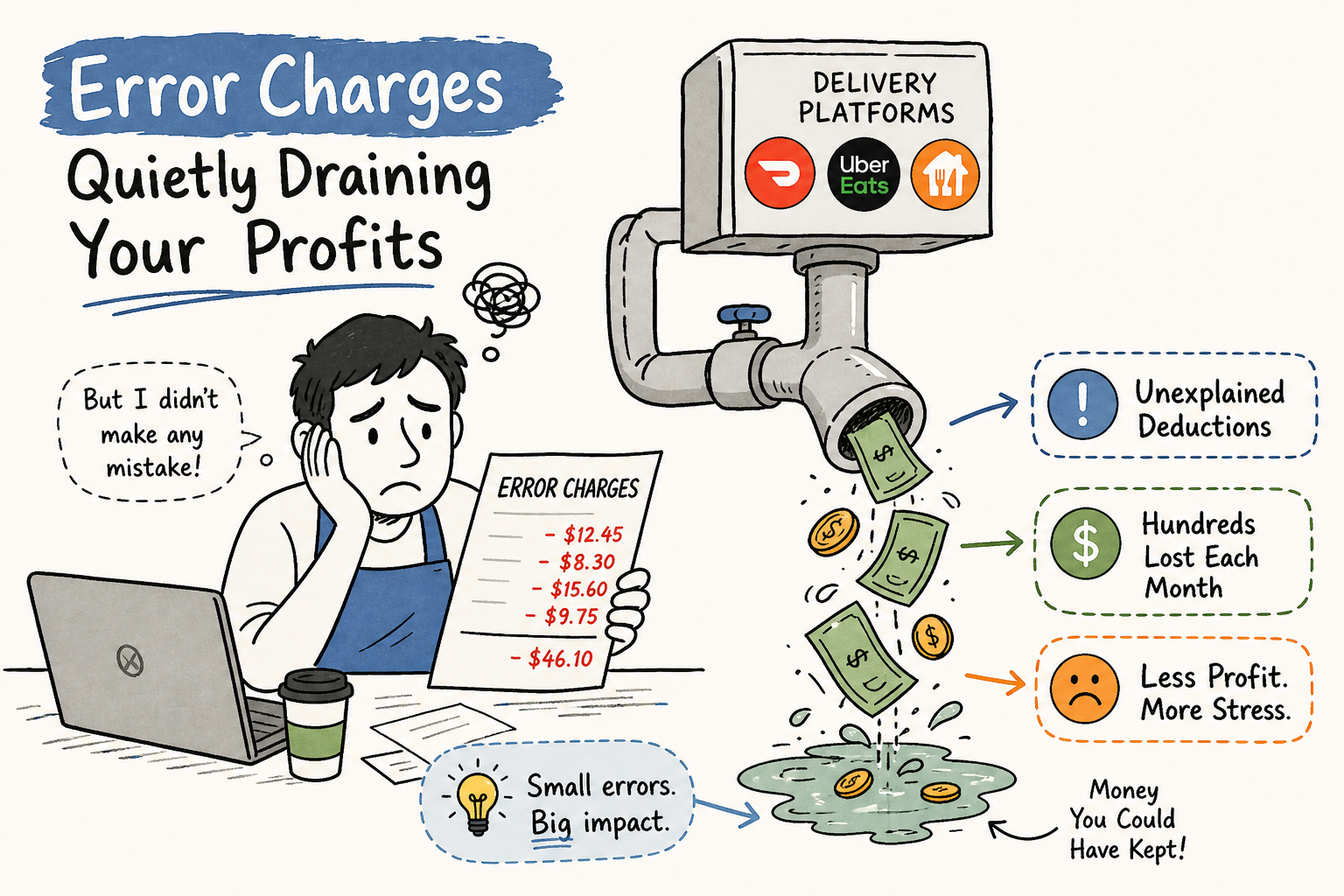
Delivery platform error charges — called order error adjustments — are deducted silently from your payout and rarely caught without a deliberate weekly audit.
Most restaurant owners think they know what they earn on delivery platforms. The orders come in, the tickets print, the payout hits the bank account. It feels like a closed loop. It isn't. Delivery platform error charges sit buried several lines down in your payout breakdown, quietly reducing what actually lands in your account every single week. They're called order error adjustments, and they're not commissions. They're not delivery fees. They're a separate charge entirely, and most operators miss them completely.
At Profit Kitchen, we've reviewed payout statements from independent restaurant operators across multiple engagements. The same pattern shows up every time: money missing with no clear explanation, no notification, and no system in place to catch it. This article breaks down exactly what these charges are, where they come from, how the major platforms calculate them, and what they're likely costing your restaurant right now.
What "order error adjustments" actually means
The official term DoorDash and Uber Eats use for these deductions is "order error adjustments." The name sounds administrative. The financial reality is not. These are delivery platform error charges applied to your account when a customer reports a problem with their order and the platform determines the fault belongs to you, the restaurant. Missing items, incorrect items, wrong orders handed to the driver, food quality complaints — all of these can trigger a deduction from your next payout.
The key detail most operators don't realize is who makes the fault determination. The platform does, not you. A customer files a complaint, the platform reviews it, and the deduction lands in your next payout cycle. In practice, merchants commonly report receiving little to no advance notification before the charge is applied. The charge appears under "Amendments" or "Error charges" in your payout report, and if you're not looking for it, you won't find it.
The calculation range makes this more serious than most operators expect. DoorDash can charge anywhere from 25% to 100% of the applicable item price plus tax. If a wrong order was handed to the Dasher, the restaurant can be charged 100% of the entire order subtotal plus tax. On a $40 order, that wipes out the full sale — and you already paid a commission on the gross sale before that deduction happened. The error charge doesn't cancel the commission. Both apply.
Uber Eats operates on a similar structure. Merchants are charged based on the refunded portion of the order, which can range from a single item to the full order value. Grubhub generally operates similarly, though merchant agreements and specific wording vary. The underlying mechanics across all three major platforms follow the same pattern, even if exact percentages differ by agreement and case type.
How delivery platform error charges appear in your payout statement
A typical delivery payout breakdown starts with gross sales, then moves to commissions, then hits a section most operators scan past: "other adjustments," "amendments," or "order error adjustments." On DoorDash, the specific line item is labeled "Error charges" under the Amendments section. On Uber Eats, it shows as "Order error adjustments" in the Payments tab of Uber Eats Manager. These items are not prominent on summary lines, and merchants commonly report not receiving clear advance notification when a charge is applied.
Delivery platforms have no financial incentive to highlight what they're deducting in error adjustments. The statements are structured to surface commission costs clearly, while adjustment lines land in a catch-all section. The practical effect is that operators who don't actively pull and review their payout detail reports never see the full picture of what their delivery operation actually costs.
Where to find error charges in DoorDash reports
In the DoorDash Merchant Portal, navigate to the Financials section and pull your weekly payout report. Look for the "Amendments" line under the deductions summary. Clicking into that line reveals the itemized error charge detail, including individual order references. Most operators never click through to that level.
Uber Eats: Payments tab breakdown
In Uber Eats Manager, go to the Payments tab and select a payout period. "Order error adjustments" appear as a separate line below the service fee. Like DoorDash, the summary view obscures the total — you need to expand the detail to see individual incident charges and their amounts.
What each platform actually holds you responsible for
DoorDash charges merchants for missing items, incorrect items, wrong orders handed to the Dasher, and quality issues determined to be the restaurant's fault. One useful protection: if a customer files a complaint more than 72 hours after delivery, DoorDash's order error adjustments policy states the platform absorbs the charge rather than passing it to the merchant. What DoorDash does not charge for includes late deliveries, no-shows by Dashers, and temperature issues caused by transit time.
Uber Eats charges merchants for missing items, incorrect items, food quality issues, and undelivered orders when the restaurant uses its own delivery staff. Uber Eats does conduct fraud checks before applying charges, but merchants rarely have visibility into what those checks found or whether the outcome could have been challenged. See the official Uber Eats guidance on order errors for timelines and evidence requirements.
Grubhub follows the same basic structure. Merchant-caused issues result in refund-related deductions, though the exact calculation method can vary based on your specific merchant agreement. The differences between platforms are mostly in the percentage ranges and the specific triggers for liability. The underlying asymmetry — where the platform decides and the merchant pays — is the same everywhere.
What delivery error charges are actually costing operators per year
Industry data puts delivery dispute losses at 2% to 5% of total delivery revenue for restaurants with meaningful platform volume. Based on commonly cited benchmarks, up to 5% of third-party orders result in some kind of dispute or adjustment. For a restaurant doing $500,000 in annual delivery revenue, a 2.5% loss rate equals $12,500 gone before the owner even knows to look for it.
The refund itself is only the visible portion of the loss. What's less obvious is everything that went into the order that's now unrecoverable: the food cost, the packaging, the labor to prepare it, and the commission already paid to the platform on the gross sale. A $40 refund doesn't cost you $40. Using a typical quick-service cost structure — roughly 28% food cost, 30% platform commission, plus packaging and labor — that $40 order costs closer to $60 to $70 in total unrecoverable expense. The commission you paid to process the order doesn't disappear when the refund hits.
At Profit Kitchen, we've surfaced this loss pattern in client payout audits repeatedly. In one engagement, we identified 18 DoorDash error charges in a single month that had been accumulating without the operator realizing it. The money wasn't taken fraudulently. It was just never tracked, never disputed, and never visible in the summary numbers the operator reviewed each week.
Why most operators never catch it
Payout statements from DoorDash, Uber Eats, and Grubhub are dense, formatted differently across platforms, and not designed to be cross-referenced against the POS. Most operators look at the deposit, compare it loosely to expected weekly revenue, and move on. The commission percentage gets attention because it's prominent and predictable. The error charge lines don't, because they're irregular and buried.
The charges also slip past because of their size. They don't typically show up as one catastrophic deduction. They come in at $15 here, $40 there, $110 on a particularly busy week. Each one feels minor in the moment. Added up over 52 weeks, they represent a real revenue leak that was invisible the entire time.
There's also no built-in tool to track them. The DoorDash Merchant Portal and Uber Eats Manager don't show you a running monthly total of what you've paid in error adjustments. You have to pull the payout data manually, export it, and add it up yourself. Most independent operators don't have the time or the system to do that. So the charges keep coming, uncontested and unchecked, week after week.
The first step to finding out what you're actually losing
The only way to know what delivery platform error charges are costing your restaurant is to look at the actual numbers. Not industry averages. Not estimates. Your specific payout history, pulled from each platform you operate on, reviewed line by line.
Once you know the number, you can act on it. Charges that fall outside the platform's stated liability rules can be disputed — but that requires the right evidence: photos of packed orders, POS receipts matching the order contents, and timestamps showing when the food was prepared and picked up. Operational fixes reduce future exposure too:
- Packing checklists verified before every bag is sealed
- Mandatory photo verification of completed orders
- POS-to-platform integrations that eliminate manual entry errors
Delivery menu pricing can also be adjusted to absorb what can't be recovered. Use the Profit Kitchen Commission Recovery Calculator to model the impact of menu and fee changes across platforms. But none of that is possible without knowing what's actually happening first. The audit is the starting point.
Stop letting your payouts lie to you
Delivery platform error charges are a real, documented, and consistently overlooked cost of running on third-party delivery apps. They're not hidden in any malicious sense — they're just structured in a way that makes them easy to miss and hard to track without a deliberate system. The operators who understand them protect their margins. The ones who don't keep watching their deposit numbers fall short of their sales numbers and assume it's just how delivery works.
It doesn't have to work that way. Pull your payout data. Find the adjustment lines. Calculate the actual cost over the last 90 days. The free 10-Point Delivery Audit walks you through exactly how to pull your payout data from DoorDash, Uber Eats, and Grubhub, what to look for in the adjustment lines, and how to calculate what error charges have cost you over the past 90 days. Know your number first. Then decide what to do about it.
What are delivery platform error charges?
Delivery platform error charges, also called order error adjustments, are deductions applied to your restaurant payout when a customer reports an order problem and the platform determines you, the merchant, are at fault. They cover missing items, incorrect items, wrong orders, and food quality complaints.
How do I find error charges in my DoorDash or Uber Eats payout?
On DoorDash, look under the Amendments section of your weekly payout report in the Merchant Portal. On Uber Eats, check the Order error adjustments line in the Payments tab of Uber Eats Manager. Both require you to drill into the detail view — the summary line alone will not show you the full cost.
Can I dispute delivery platform error charges?
Yes. Charges that fall outside the platform's stated liability policy can be contested. Strong evidence includes timestamped photos of packed orders, POS receipts matching order contents, and pickup timestamps. The dispute window is typically limited, so act promptly.
How much are error charges typically costing restaurants?
Industry benchmarks suggest restaurants with meaningful delivery volume lose between 2% and 5% of total delivery revenue to dispute-related adjustments annually. For a restaurant doing $500,000 in delivery sales, that is $10,000 to $25,000 per year — most of it never noticed or disputed.
See What Error Charges Are Costing Your Restaurant
The free 10-Point Delivery Audit walks through your payout data, finds the adjustment lines, and shows you the real number. Free. Takes 15 minutes.
Get the Free Delivery Audit →